KitchenAid Garbage Disposals. Models, Specs, and Our Honest Review
KitchenAid makes a lineup of garbage disposals ranging from 1/2 HP to 1 HP batch-feed models, priced from around $147 to $499. Before you buy, there is one fact worth knowing up front: KitchenAid disposals are manufactured by InSinkErator under an OEM agreement with Whirlpool Corporation, which acquired the KitchenAid brand in 1986. The internal architecture is essentially the same as InSinkErator’s own models. That matters for your purchase decision, and we’ll explain exactly what it means below.
For a broader look at all major brands, see our best garbage disposal buying guide.
Quick specs: KitchenAid disposal model comparison
KitchenAid offers a full lineup on their official disposal page, but here is the model-by-model breakdown with specs and pricing side by side:
| Model | HP | Feed Type | MultiGrind Stages | Approx. Price | Warranty |
|---|---|---|---|---|---|
| KCDB250G | 1/2 | Continuous | 2-stage | ~$147 | 2 years |
| KCDS075T | 3/4 | Continuous | 2-stage | ~$103–$285 | 2 years |
| KGCP334RXX | 3/4 | Continuous | 3-stage | ~$230 | 3 years |
| KCDS100T | 1 | Continuous | 3-stage | ~$379 | 4 years |
| KGCP710RXX | 1 | Continuous | 4-stage | ~$398 | 4 years |
| KBDS100T | 1 | Batch feed | 4-stage | ~$499 | 4 years |
Notes on compatibility:
- All KitchenAid disposals use the 3-bolt Quick Lock mounting system, compatible with most standard sinks
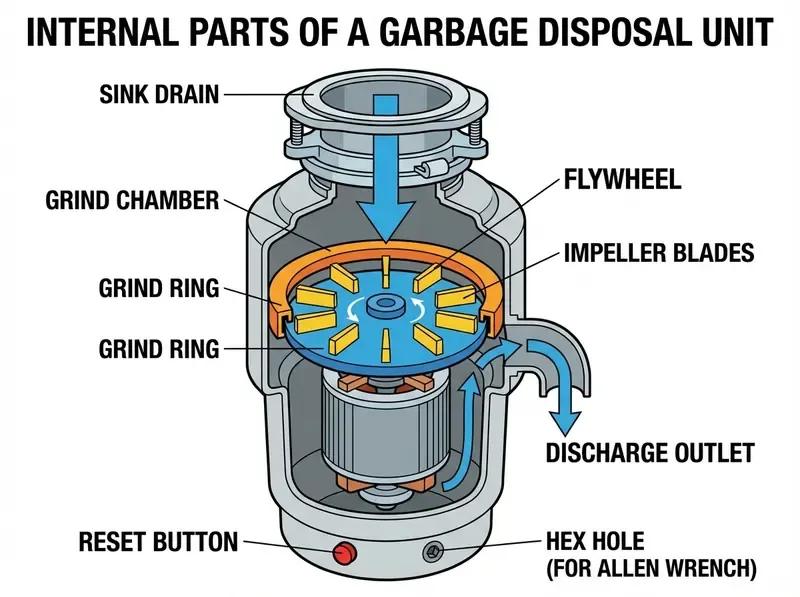
- Reset button: red button on the bottom of each unit (same location as InSinkErator models)
- Standard drain opening: 3.5 inches across all models
- Jam clearing: 1/4-inch Allen wrench in the hex hole on the bottom
The KCDS075T is the most reviewed KA model at 4.8/5 stars across 614 reviews; the KCDB250G follows at 4.6/5 across 532 reviews. The product quality is real. The question is whether the premium over equivalent InSinkErator models is justified.
What we found: the InSinkErator connection
KitchenAid garbage disposals are manufactured by InSinkErator under a Whirlpool OEM agreement. The internal components, grind stages, mounting hardware, and reset mechanism, are architecturally identical to InSinkErator models. Shoppers who do not need the KitchenAid branding typically find an equivalent InSinkErator disposal for 10–20% less.
Consumer Reports states this plainly: “InSinkErator manufactures KitchenAid garbage disposals, so you can expect some of the same features, such as multistage grind technology and sound reduction features.” InSinkErator holds roughly 70% of the US residential disposal market, so the OEM relationship is with the dominant manufacturer, not a generic supplier.
In practical terms, this means:
- KitchenAid’s “MultiGrind Technology” is InSinkErator’s multi-stage grind system under a different name
- The 3-bolt Quick Lock mounting system is InSinkErator’s own standard
- Reset button location, jam-clearing procedure, and Allen wrench size are identical across both brands
- InSinkErator troubleshooting guides apply directly to KA units
Where the premium shows up in the price:
The KA KCDS075T (3/4 HP continuous) runs around $285 at mid-market retail. InSinkErator’s own Evolution Compact (3/4 HP) runs around $200, that’s roughly a 40% premium for equivalent grinding power and a shared OEM architecture. The Badger 5 (1/2 HP) runs $100–$150, which is not a direct comparison but shows how much farther InSinkErator’s own lineup goes on price.
For context on how InSinkErator and Waste King compare at similar price points, see that guide. And if you already know the HP you need, the garbage disposal HP sizing guide covers the sizing math for different household sizes.
The Consumer Reports garbage disposal guide covers independent testing of major brands if you want third-party performance data beyond manufacturer specs.
Common problems and fixes
KitchenAid disposals fail in the same ways as InSinkErator models, the OEM relationship means the same root causes and the same fixes apply.
Reset button tripped (most common issue)
The red reset button on the bottom of the unit pops out when the disposal overloads. Press it firmly until it clicks. If it trips again within seconds of restarting, the flywheel is still jammed or the motor is overheating. Wait 15 minutes before the next reset attempt. For full step-by-step instructions, see KitchenAid’s official reset instructions.
Jammed flywheel
Insert a 1/4-inch Allen wrench into the hex hole on the bottom of the unit and rotate it back and forth to free the grinding plate. This works on all KitchenAid models and is the same procedure as InSinkErator. Run cold water, then restart after clearing the jam.
Disposal hums but won’t spin
This almost always means a jammed flywheel, not a motor failure. The motor is running but the plate cannot turn. Use the Allen wrench method above. If the wrench turns freely but the unit still hums after restart, unplug the disposal for 10 minutes to let the motor cool, then press the reset button and try again.
Parts availability note: KA-specific replacement parts can be harder to find at local hardware stores than InSinkErator parts. RepairClinic and PartSelect both stock KitchenAid disposal components. Because of the shared OEM architecture, some InSinkErator parts are cross-compatible, but verify part numbers before ordering.
Is it worth it? Honest verdict
KitchenAid makes a well-built disposal. The 4.6–4.8 star ratings across hundreds of reviews confirm the product quality holds up. The question is whether the brand premium over equivalent InSinkErator models makes sense for your situation.
Buy KitchenAid if:
- You are completing a KitchenAid appliance suite (mixer, range, dishwasher) and brand consistency matters to you
- You are buying it as a gift where the branded packaging adds value
- You specifically want a batch-feed disposal, the KBDS100T at $499 is a genuinely differentiated product type with fewer direct InSinkErator Badger equivalents at the same spec
Consider alternatives if:
- You are a budget buyer: Waste King L-8000 (1 HP) runs $150–$200 with a 20-year warranty versus $379–$499 for KA’s 1 HP models with a 4-year warranty. For sheer value per dollar, the Waste King wins outright
- You are a savvy DIYer who knows the OEM relationship: the InSinkErator Badger 5 review covers the same underlying platform at a lower price
- You want the best warranty in the category: Waste King’s 20-year warranty on the L-8000 is the benchmark; KA’s 2–4 year warranties do not compare favorably
- You are on a septic system: check model-specific septic compatibility rather than assuming any brand is automatically septic-safe
For anyone thinking about replacing rather than just buying new, see our guide on replacing a garbage disposal and garbage disposal installation for what the full job involves.
FAQ
Is an InSinkErator the same as a KitchenAid garbage disposal?
Yes, effectively. InSinkErator manufactures KitchenAid disposals under an OEM contract with Whirlpool Corporation, which owns the KitchenAid brand. The internal components, grind stages, mounting system, and reset mechanism, share the same architecture. KitchenAid’s “MultiGrind Technology” is InSinkErator’s multi-stage grind system under a different name. The primary difference is branding and price: KA models typically cost 10–20% more than comparable InSinkErator models.
Is there a reset button on a KitchenAid garbage disposal?
Yes. Every KitchenAid disposal has a small red reset button on the bottom of the unit, at the center. Press it firmly until it clicks. If the button pops back out immediately after restarting, the disposal is still jammed or the motor needs to cool down. Wait 15 minutes and try again after clearing any jam with a 1/4-inch Allen wrench.
How long does a KitchenAid garbage disposal last?
10–12 years with normal use, per InterNACHI home inspection guidelines. Proper use extends lifespan: run cold water during grinding and for 20–30 seconds after, avoid fibrous or starchy foods (celery, potato peels, pasta), and never pour grease down the disposal. KitchenAid disposals carry 2–4 year manufacturer warranties depending on the model.
What HP KitchenAid disposal do I need?
1/2 HP (KCDB250G) for 1–2 person households with light food waste; 3/4 HP (KCDS075T) for 3–4 person households with average use; 1 HP (KCDS100T or KGCP710RXX) for heavy use or households of 5 or more. See our garbage disposal HP sizing guide for the full breakdown.
Why is my KitchenAid garbage disposal not working?
The most common causes are: (1) tripped reset button, press the red button on the bottom of the unit; (2) jammed flywheel, insert a 1/4-inch Allen wrench in the hex hole at the bottom and rotate to free the plate; (3) no power, check that the unit is plugged in and the circuit breaker has not tripped. If none of these resolve it, the motor may have failed, which typically means replacement rather than repair.